
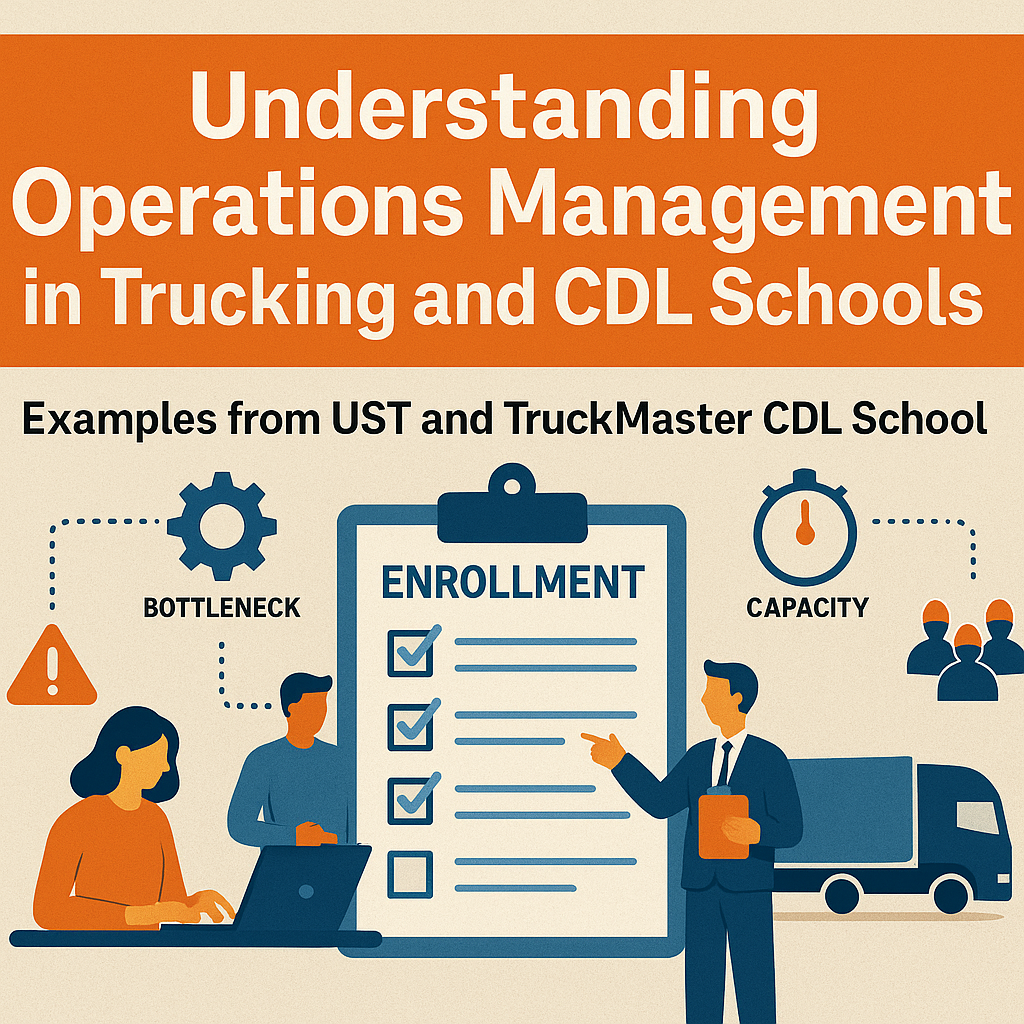
How Operations Management Works in a CDL School and Trucking Company
By Fuad Aghayev — Founder of UST & TruckMaster CDL School
Running a trucking company or a CDL school is not just about trucks, drivers, or students. It’s about managing processes. Every business—big or small—runs on systems. And when those systems are organized the right way, the whole company becomes smoother, faster, safer, and more profitable.
In my Operations Management course, I recently studied an example from Subway restaurants. They break the work into steps and assign different team members to each part. When you understand this, operations suddenly becomes very simple.
Let me explain these concepts using real examples from my own businesses:
✔ TruckMaster CDL School
✔ UST (United States Trucks LLC)
What Is Operations Management?
Operations management means:
Designing, organizing, and improving all the steps that deliver your service.
In the trucking and CDL industry, this includes:
- Student onboarding
- Driver onboarding
- Dispatch workflow
- Safety & compliance
- Fleet maintenance
- Load planning
- Payment and back-office operations
If each step is slow or messy, the whole business becomes slow or messy.
If each step is clean and efficient, the business runs like a machine.
Example: Student Enrollment at TruckMaster CDL School
Let’s walk through the exact workflow of enrolling a new CDL student.
There are three steps:
Step 1 — Reception & Welcome (10 min)
- Greeting
- Checking ID
- Giving the application forms
- Explaining the program
Step 2 — Paperwork & Contract (20 min)
- Enrollment agreement
- Payment plan
- Policies and signatures
- Inputting info into system
Step 3 — Payment & Scheduling (10 min)
- Taking payment
- Adding student to WhatsApp group
- Booking DMV appointment
- Scheduling training dates
Total labor time per student = 40 minutes.
Where Operations Management Helps
In operations, we measure the capacity of each step.
✔ Step 1 Capacity
60 min / 10 min = 6 students/hour
✔ Step 2 Capacity
60 min / 20 min = 3 students/hour → bottleneck
✔ Step 3 Capacity
60 min / 10 min = 6 students/hour
The bottleneck (slowest step) controls the entire system.
👉 Even if Step 1 and Step 3 can handle 6 students/hour…
👉 Step 2 can only handle 3/hour.
👉 So the whole school can only enroll 3 students per hour.
This is why some businesses feel “stuck” — without realizing it, one step is slowing everything down.
What Happens With Higher Demand?
Let’s say 5 students per hour want to enroll.
But Step 2 can only handle 3 per hour.
Flow rate (actual speed of business)
Flow Rate=min(Demand,Capacity)=3\text{Flow Rate} = \min(\text{Demand}, \text{Capacity}) = 3Flow Rate=min(Demand,Capacity)=3
Utilization (how busy employees are)
- Step 1 → 50%
- Step 2 → 100%
- Step 3 → 50%
This tells us:
- Admin doing contracts is overloaded
- Reception and payment staff are under-utilized
- Students wait longer → bad service
This is operations management in real life.
Real Example: Onboarding 10 Students at Once
Just like the Subway case, we calculate how long 10 students take.
- First student takes 40 minutes (full process)
- After that, every new student completes every 20 minutes (cycle time)
40+(10−1)×20=220 minutes40 + (10 – 1) \times 20 = 220 \text{ minutes}40+(10−1)×20=220 minutes
It takes 3 hours 40 minutes to fully enroll 10 students.
Now imagine a busy Monday morning — this is why the school sometimes feels “backed up.”
How to Fix This? (Improvement Plan)
Option 1 — Add a second admin for Step 2
Now Step 2 capacity becomes:
2 admins × (60/20) = 6 students/hour
Boom.
Every step now handles 6 students/hour.
Flow rate becomes 5 per hour (full demand).
Cycle time drops from 20 minutes to 12 minutes.
10-student enrollment drops from 3h40m → 2h28m.
Massive improvement from one change.
Example from UST Trucking: Driver Onboarding
Driver onboarding also has multiple steps:
- Background check (15 min)
- Drug test scheduling (5 min)
- Safety orientation (45 min)
- ELD setup + app training (20 min)
- Truck handover (15 min)
Total: 100 minutes
But safety orientation (45 min) controls the entire capacity.
This is why some carriers with 200 trucks struggle while others with 50 trucks run smooth —
not because of size, but because of process design.
The Power of Good Operations
When your operations are clean:
- Students finish faster
- Drivers onboard smoothly
- Dispatchers work less under pressure
- Trucks move more miles
- Fewer accidents
- Higher Amazon score
- Higher profits
Operations management turns chaos into calm.
It is the difference between a company that scales and a company that collapses.
Final Thoughts from Fuad
The more I study operations management, the more I understand why big companies win.
Not because of luck.
Not because of money.
But because their systems are organized.
TruckMaster CDL School, UST, and A2Z Tracking Solutions are growing fast, and I want to build them on strong foundations. Learning operations management is one of the most powerful investments in the whole journey.
If you want to scale a trucking business, remember:
Fix the process → Fix the problems → Grow the business.